
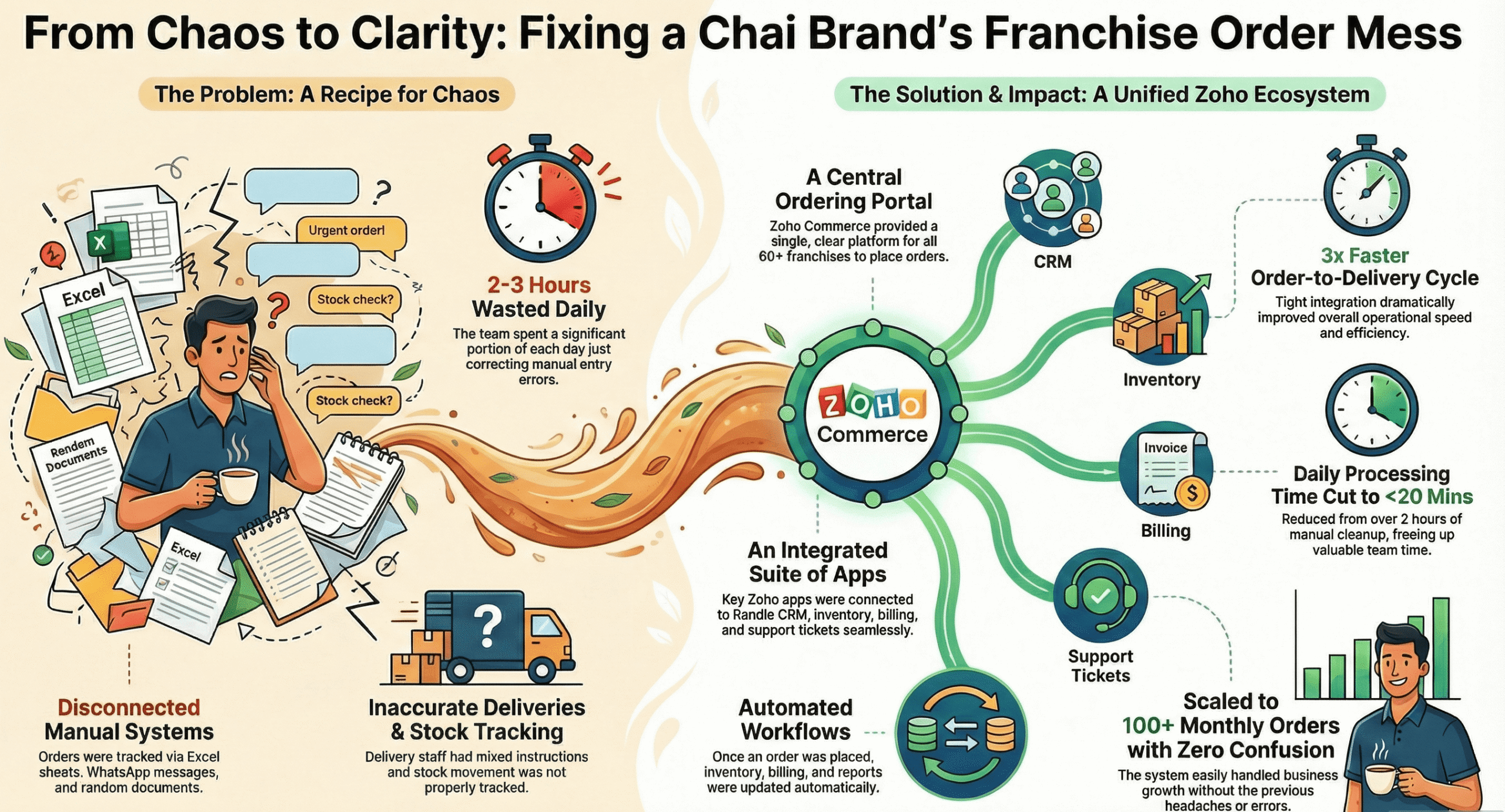
Case Study: How We Fixed a Chai Brand’s Franchise Order Mess With Zoho
When this client reached out to us, they were running a fast-growing chai business with a simple dream: serve great chai across their franchise network without chaos. But behind the scenes, their process was nothing short of a daily struggle.
Most of their day-to-day work ran on Excel sheets, WhatsApp notes, random documents, and a whole lot of “please check again” messages. Orders from franchises were often mixed up. Delivery staff showed up with the wrong stock. Franchise owners kept calling them to check why their order wasn’t delivered, or why the list didn’t match what they submitted.
It wasn’t that they lacked effort. They lacked a proper system. And because everything depended on manual entries, they lost 2 to 3 hours every day just cleaning up mistakes.
That’s the state they were in when they came to us.
What Was Going Wrong
From the first call itself, it was clear that the core issues were simple:
- Franchise orders weren’t captured clearly
Each franchise had its own way of sharing order details. One sent a sheet. Another sent a WhatsApp message. Another used a printed list. So the head office spent half the day figuring out which order was the latest one. - Delivery staff didn’t have a clean list
They got mixed instructions because everything depended on manual consolidation. They often took the wrong items, or missed items. - Stock movement wasn’t tracked
Without proper tracking, the client didn’t know how much raw material went where. That also affected billing. - No place to raise issues
Whenever a franchise faced a problem, they called or messaged someone. It got buried. No follow-up. No tracking.
They knew they needed structured apps, but they didn’t know which ones. That’s where we stepped in.
How We Planned the Solution
We sat with them, asked a lot of questions, understood their routine, how each franchise works, how the warehouse team functions, how the deliveries happen, and so on.
Once the picture was clear, we suggested a combo of apps that would work tightly together:
- Zoho Commerce to build a franchise ordering portal
- Zoho Creator for custom functions they wanted
- Zoho CRM to manage franchise profiles
- Zoho Books for billing
- Zoho Inventory for stock tracking
- Zoho Desk for ticketing and issue tracking
Each app would take care of a certain piece of the puzzle, but would also sync with the others to keep everything updated in one flow.
They liked the idea because they wanted something steady, simple for their staff, and easy for their franchises.
Building the Franchise Ordering Portal
We started with Zoho Commerce because that was the heart of the system. Franchises needed a place to log in and submit their orders without confusion.
What we built:
- Each franchise got its own login.
- They could view products, stock availability, and pricing.
- They could place orders with a few clicks.
- Each order directly synced to the backend.
No more WhatsApp messages. No more Excel sheets.
Before this, they had more than 60 franchises sending orders in different formats. After the portal, all 60+ came into one neat system.
CRM and Inventory Work
Next, we synced Zoho CRM with Commerce.
Every franchise had a clean profile:
- Franchise name
- Order history
- Contact details
- Status of deliveries
- Notes
This made it easier for the back office team to track who placed what.
We also tied Zoho Inventory into the system so stock movement was tracked automatically.
What used to take them hours to calculate now happened in a couple of seconds. Stock numbers stayed updated across Commerce, Inventory, and Books.
Adding Custom Features with Zoho Creator
The client had additional needs that didn’t fit directly into standard modules. So we built a custom dashboard in Zoho Creator.
This dashboard showed:
- Total orders
- Delivery status
- Order-wise item quantity
- Alerts for low stock
- Internal notes
- Quick reports
This screen became their daily control center. The management team used it all the time.
Billing With Zoho Books
As soon as an order was approved, the system pushed everything into Zoho Books. Bills were generated automatically. No more manual entry.
Before this, they used to punch around 100+ invoices every month manually. Now it happened in a few clicks.
Ticketing Setup in Zoho Desk
Issues from franchises were another headache. Calls got missed. Follow-ups got delayed. There was no clean trail.
So we set up Zoho Desk:
- Each franchise could raise a ticket.
- The support team saw all tickets in one place.
- Status changes were visible to both sides.
- Nothing got lost.
Most internal confusion vanished.
How the System Worked Together
Once all apps were connected, the entire setup became a closed environment. Each app talked to the other. No loose ends.
- Orders placed in Commerce showed up in Creator and CRM.
- Stock movement synced with Inventory.
- Billing synced with Books.
- Issues came into Desk.
Everything updated instantly.
This tight integration removed manual work and reduced human mistakes. What used to take them 2–3 hours daily now took a few minutes.
The Results
Once the system went live, the impact was visible within the first month.
1. They handled 60+ franchises without confusion
Earlier, 60 franchises meant 60 headaches. After this, everything came in clean and sorted.
2. Monthly orders crossed 100+
Because the ordering portal was easier to use, franchises submitted orders faster and on time. No delays.
3. Daily processing time dropped
From 2–3 hours of manual cleanup to
less than 20 minutes.
Their team finally stopped spending mornings fixing mistakes.
4. Delivery accuracy increased
Delivery staff received the exact list connected to the system. No mix-ups.
5. Speed improved 3x
Order-to-delivery flow became much faster.
Reports came instantly.
Stock checks were reliable.
6. Everything stayed connected
Because the environment was closed and all apps were integrated tightly, they didn’t have to enter anything twice. That alone saved countless hours.
As a Partner, Here’s What the Project Felt Like
This wasn’t one of those clean, straight projects where everything is clear from day one. Their process had a lot of moving parts, and everyone had their own way of doing things.
The biggest challenge was translating their daily routine into system logic. They used to change orders midway, update quantities over calls, and re-confirm deliveries again and again. So we had to create checks to prevent mistakes but still keep the flow flexible.
Working with Zoho Commerce for franchise ordering was fun. Most people use Commerce for normal e-commerce stores. Using it for a franchise supply chain needed some tweaks, but it worked well once we linked it with Inventory and Books.
Zoho Creator was also a good choice here because they needed screens that were not part of standard apps. Creator became our playground. We built dashboards, alerts, and custom reports that made sense for them.
The tight connection between CRM, Books, Inventory, and Desk made the system feel like one product. Once everything was wired together, the client could run their chai supply chain without touching a single sheet of Excel.
When they told us their entire order cycle became three times faster, that felt great because that’s the kind of number that shows real impact.
What the Client Gained
If I have to sum it up in simple points:
- Their franchises stopped calling every day for basic info.
- Their orders became clean and trackable.
- Their delivery staff got the correct lists.
- Their billing became accurate.
- Their stock history stayed updated.
- Their issues were actually tracked and solved.
- Their team saved around 2–3 hours every single day.
- They could scale without fear of mistakes.
This setup will stay useful for them even when they reach 100+ franchises.
Closing Thoughts
This project was a great example of how a chai business with scattered workflows can shift into a steady system with the right apps stitched together. Nothing fancy. Just the right tools talking to each other in a clean flow.
And as developers, watching their daily operations turn from “chaos and rework” to “smooth and consistent” felt like the best outcome.
If you need the same type of case study in another tone or want a shorter or longer version, tell me.